Flipping the Lights on Cosmic Darkness

Exploring the universe is a bit like groping around a dark room. Aside from the occasional pinprick of starlight, most objects lurk in pitch darkness. But with the recent launch of the largest-ever infrared space telescope, it’s like someone walked into the room and flipped on the lights.

Suddenly, those dark spaces between stars don’t appear quite so empty. Reflected in the Herschel Space Observatory’s 3.5-meter primary mirror, astronomers can now see colder, darker celestial objects than ever before—from the faint outer arms of distant galaxies to the stealthy “dark asteroids” of our own solar system.

Many celestial objects are too cold to emit visible light, but they do shine at much longer infrared wavelengths. And Herschel can observe much longer infrared wavelengths than any space telescope before (up to 672 microns). Herschel also has 16 times the collecting area, and hence 16 times better resolution, than previous infrared space telescopes. That lets it resolve details with unprecedented clarity. Together, these abilities open a new window onto the universe.

”The sky looks much more crowded when you look in infrared wavelengths,” says George Helou, director of the NASA Herschel Science Center at Caltech. “We can’t observe the infrared universe from the ground because our atmosphere blocks infrared light, and emits infrared itself. Once you get above the atmosphere, all of this goes away and suddenly you can look without obstruction.”

Herschel launched in May from the Guiana Space Centre in French Guiana aboard a European Space Agency Ariane 5 rocket. Since then, it has expanded the number of distant galaxies observed at far infrared wavelengths from a few hundred to more than 28,000. And with the instrument testing and system check-out phases finally completed, the discoveries are only now beginning.

Beyond simply imaging these dark objects, Herschel can identify the presence of chemicals such as carbon monoxide and water based on their spectral fingerprints. “We will be able to decipher the chemistry of what’s going on during the beginnings of star formation, in the discs of dust and gas that form planets, and in the lingering aftermath of stellar explosions,” Helou says.

And those are just the expected things. Who knows what unexpected discoveries may come from “flipping on the lights?” Helou says “we can’t wait to find out.”

Herschel is a European Space Agency mission, with science instruments provided by a consortium of European-led institutes and with important participation by NASA. See the ESA Herschel site at sci.esa.int/science-e/www/area/index.cfm?fareaid=16. Also, see the NASA sites at herschel.jpl.nasa.gov, www.herschel.caltech.edu, and www.nasa.gov/mission_pages/herschel. Kids can learn about infrared light by browsing through the Infrared Photo Album at The Space Place, spaceplace.nasa.gov/en/kids/sirtf1/sirtf_action.shtml.

This article was provided courtesy of the Jet Propulsion Laboratory, California Institute of Technology, under a contract with the National Aeronautics and Space Administration.
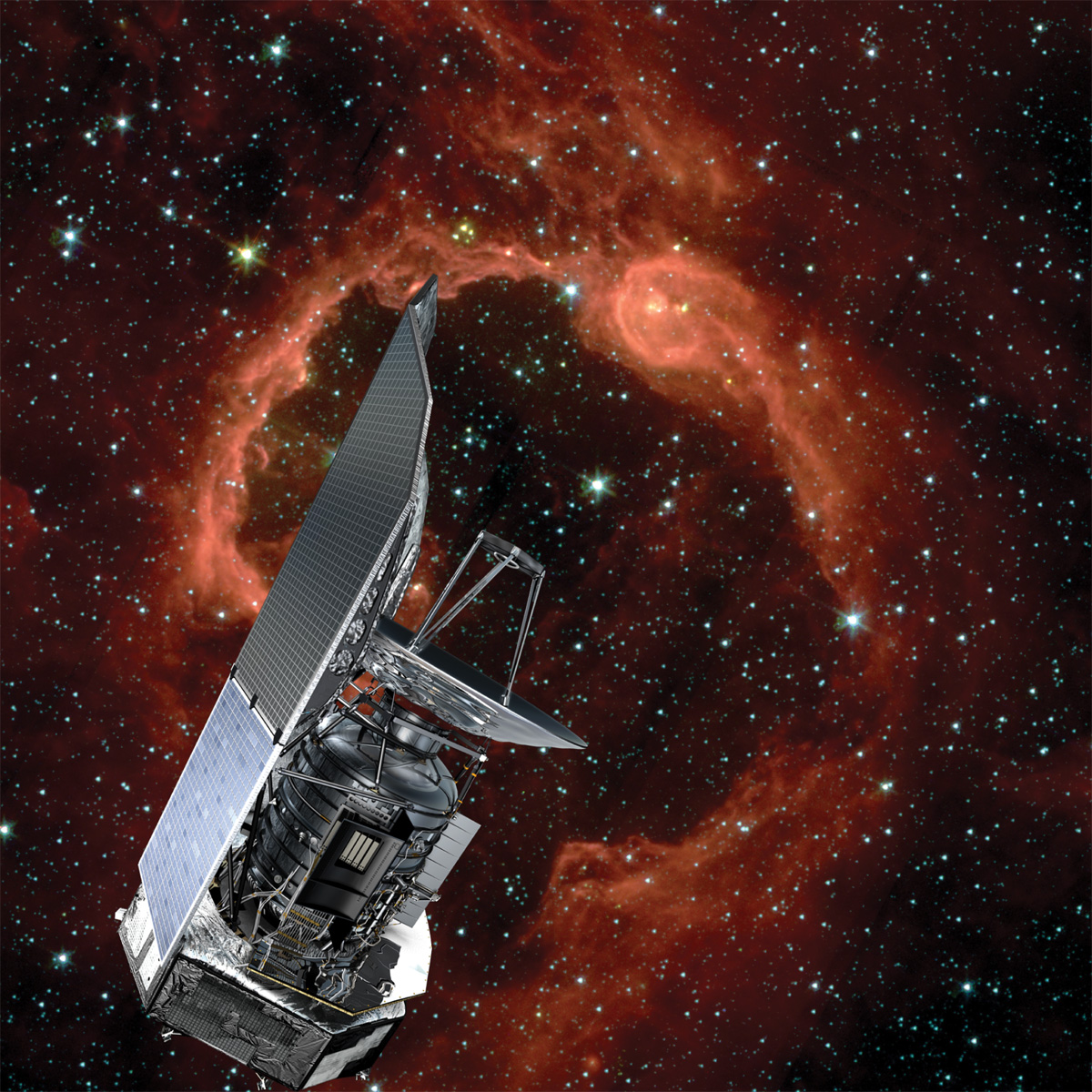
Caption:

The Herschel Space Observatory has 3.5-meter primary mirror, allowing astronomers to see colder, darker celestial objects than ever before.

A Cosmic Crash by Patrick Barry and Dr. Tony Phillips

Two small planets hurtle toward each other at 22,000 miles per hour. They’re on a collision course. With unimaginable force, they smash into each other in a flash of light, blasting streams of molten rock far out into space.

This cataclysmic scene has happened countless times in countless solar systems. In fact, scientists think that such collisions could have created Earth’s moon, tilted Uranus on its side, set Venus spinning backward, and sheared the crust off Mercury.

But witnessing such a short-lived collision while pointing your telescope in just the right direction would be a tremendous stroke of luck. Well, astronomers using NASA’s Spitzer space telescope recently got lucky.

“It’s unusual to catch such a collision in the act, that’s for sure,â€? said Geoffrey Bryden, A cosmic Crashspitzer_an astronomer specializing in extrasolar planet formation at NASA’s Jet Propulsion Laboratory and a member of the science team that made the discovery.

When Bryden and his colleagues pointed Spitzer at a star 100 light-years away called HD 172555, they noticed something strange. Patterns in the spectrum of light coming from nearby the star showed distinctive signs of silicon monoxide gas — huge amounts of it — as well as a kind of volcanic rock called tektite.

It was like discovering the wreckage from a cosmic car crash. The silicon monoxide was produced as the high-speed collision literally vaporized huge volumes of rock, which is made largely of silicon and oxygen. The impact also blasted molten lava far out into space, where it later cooled to form chunks of tektite.

Based on the amount of silicon monoxide and tektites, Bryden’s team calculated that the colliding planetary bodies must have had a combined mass more than twice that of Earth’s moon. The collision probably happened between 1,000 and 100,000 years ago — a blink of an eye in cosmic terms.

The scientists used the Spitzer space telescope because, unlike normal telescopes, Spitzer detects light at invisible, infrared wavelengths.

“Spitzer wavelengths are the best wavelengths to identify types of rock,â€? Bryden says. “You can pin down which type of rock, dust, or gas you’re looking at.â€?

Bryden says the discovery provides further evidence that planet-altering collisions are more common in other star systems than people once thought. The “crash-bang” processes at work in our own solar system may indeed be universal. If so, Spitzer has a front row seat on a truly smashing show.

See Spitzer Space Telescope’s brand new Web site at http://spitzer.caltech.edu/. Kids can learn about infrared light and see beautiful Spitzer images by playing the new Spitzer Concentration game at http://spaceplace.jpl.nasa.gov/en/kids/spitzer/concentration.

This article was provided by the Jet Propulsion Laboratory, California Institute of Technology, under a contract with the National Aeronautics and Space Administration.

Planetary Demolition Derby

Caption:

Artist’s rendering of cosmic collision involving two objects whose combined mass was at least twice that of our Moon. Discovered using the Spitzer Space Telescope in the planetary system of a star called HD 172555 100 light-years away.

Staring at Lightning

spaceplaceThere’s something mesmerizing about watching a thunderstorm. You stare at the dark, dramatic clouds waiting for split-second bursts of brilliant light — intricate bolts of lightning spidering across the sky. Look away at the wrong time and (FLASH!) you miss it.

Lightning is much more than just a beautiful spectacle, though. It’s a window into the heart of the storm, and it could even provide clues about climate change.earth_lightningThe

Strong vertical motions within a storm cloud help generate the electricity that powers lightning. These updrafts are caused when warm, moist air rises. Because warmth and lightning are inextricably connected, tracking long-term changes in lightning frequency could reveal the progress of climate change.

It’s one of many reasons why scientists want to keep an unwavering eye on lightning. The best way to do that? With a satellite 35,800 km overhead.

At that altitude, satellites orbit at just the right speed to remain over one spot on the Earth’s surface while the planet rotates around its axis — a “geostationaryâ€? orbit. NASA and NOAA scientists are working on an advanced lightning sensor called the Geostationary Lightning Mapper (GLM) that will fly onboard the next generation geostationary operational environmental satellite, called GOES-R, slated to launch around 2015.

“GLM will give us a constant, eye-in-the-sky view of lightning over a wide portion of the Earth,â€? says Steven Goodman, NOAA chief scientist for GOES-R at NASA’s Goddard Space Flight Center. Once GLM sensors are flying on GOES-R and its sister GOES-S, that view will extend 18,000 km from New Zealand, east across the Pacific Ocean, across the Americas, and to Africa’s western coast.

With this hemisphere-scale view, scientists will gather an unprecedented amount of data on how lightning varies from place to place, year to year, and even decade to decade. Existing lightning sensors are either on the ground — which limits their geographic range — or on satellites that orbit much closer to Earth. These satellites circle the Earth every 90 minutes or so, quickly passing over any one area, which can leave some awkward gaps in the data.

Goodman explains: “Low-Earth orbit satellites observe a location such as Florida for only a minute at a time. Many of these storms occur in the late afternoon, and if the satellite’s not overhead at that time, you’re going to miss it.â€?

GLM, on the other hand, won’t miss a thing.  Indeed, in just two weeks of observations, GLM is expected gather more data than NASA’s two low-Earth orbiting research sensors did in 10+ years.

The new data will have many uses beyond understanding climate change. For example, wherever lightning flashes are abundant, scientists can warn aircraft pilots of strong turbulence.  The data may also offer new insights into the evolution of storms and prompt improvements in severe weather forecasting.

Staring at

(FLASH!)  Did you miss another one?  The time has come for GLM.

Want to know how to build a weather satellite? Check the “how toâ€? booklet at scijinks. gov/weather/technology/build_satellite.

This article was provided by the Jet Propulsion Laboratory, California Institute of Technology, under a contract with the National Aeronautics and Space Administration.

earth_lightning
The Geostationary Lightning Mapper (GLM) on the next generation of GOES satellites will detect the very rapid and transient bursts of light produced by lightning at near-infrared wavelengths. This image was taken from the International Space Station and shows the Aurora Australis and lightning.