Black Holes No Joke by Dr. Tony Phillips

Kip Thorne: Why was the black hole hungry?

Stephen Hawking: It had a light breakfast!

Black hole humor—you gotta love it.  Unless you’re an astronomer, that is.  Black holes are among the most mysterious and influential objects in the cosmos, yet astronomers cannot see into them, frustrating their attempts to make progress in fields ranging from extreme gravity to cosmic evolution.

How do you observe an object that eats light for breakfast?

“Black holes are creatures of gravity,” says physicist Marco Cavaglia of the University of Mississippi.  “So we have to use gravitational waves to explore them.”

Enter LIGO—the NSF-funded Laser Interferometer Gravitational-wave Observatory.  According to Einstein’s Theory of General Relativity, black holes and other massive objects can emit gravitational waves—ripples in the fabric of space-time that travel through the cosmos.  LIGO was founded in the 1990s with stations in Washington state and Louisiana to detect these waves as they pass by Earth.

“The principle is simple,” says Cavaglia, a member of the LIGO team.  “Each LIGO detector is an L-shaped ultra-high vacuum system with arms four kilometers long.  We use lasers to precisely measure changes in the length of the arms, which stretch or contract when a gravitational wave passes by.”

Just one problem: Gravitational waves are so weak, they change the length of each detector by just 0.001 times the width of a proton!  “It is a difficult measurement,” allows Cavaglia.

Seismic activity, thunderstorms, ocean waves, even a truck driving by the observatory can overwhelm the effect of a genuine gravitational wave.   Figuring out how to isolate LIGO from so much terrestrial noise has been a major undertaking, but after years of work the LIGO team has done it.  Since 2006, LIGO has been ready to detect gravitational waves coming from spinning black holes, supernovas, and colliding neutron stars anywhere within about 30 million light years of Earth.

So far the results are … nil. Researchers working at dozens of collaborating institutions have yet to report a definite detection.

Does this mean Einstein was wrong?  Cavaglia doesn’t think so.  “Einstein was probably right, as usual,” he says.  “We just need more sensitivity.  Right now LIGO can only detect events in our little corner of the Universe.  To succeed, LIGO needs to expand its range.”

So, later this year LIGO will be shut down so researchers can begin work on Advanced LIGO—a next generation detector 10 times more sensitive than its predecessor.  “We’ll be monitoring a volume of space a thousand times greater than before,” says Cavaglia. “This will transform LIGO into a real observational tool.”

When Advanced LIGO is completed in 2014 or so, the inner workings of black holes could finally be revealed.  The punchline may yet make astronomers smile.

Find out more about LIGO at http://www.ligo.caltech.edu/. The Space Place has a LIGO explanation for kids (of all ages) at http://spaceplace.nasa.gov/en/kids/ligo, where you can “hear” a star and a black hole colliding!

This article was provided by the Jet Propulsion Laboratory, California Institute of Technology, under a contract with the National Aeronautics and Space Administration.
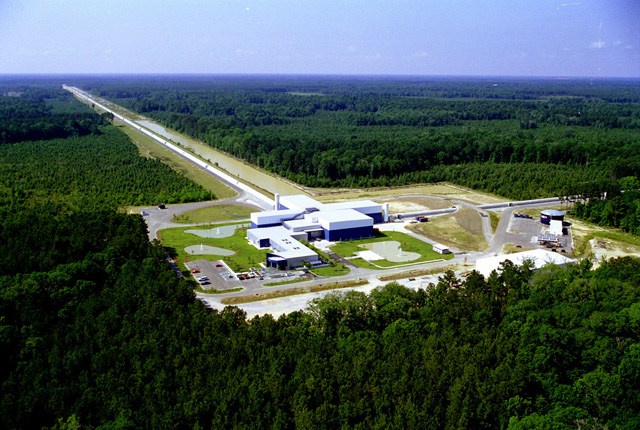
Caption:

Laser Interferometer Gravitational-wave Observatory in Livingston, Louisiana. Each of the two arms is 4 kilometers long. LIGO has another such observatory in Hanford, Washington.

Ancient Supernova Riddle, Solved

By Dr. Tony Phillips

Australopithecus squinted at the blue African sky. He had never seen a star in broad daylight before, but he could see one today. Was it dangerous? He stared for a long time, puzzled, but nothing happened, and after a while he strode across the savanna unconcerned.

Millions of years later, we know better.

That star was a supernova, one of many that exploded in our corner of the Milky Way around the Pliocene era of pre-humans.  Australopithecus left no records; we know the explosions happened because their debris is still around. The Solar System and everything else within about 300 light-years is surrounded by supernova exhaust—a haze of million-degree gas that permeates all of local space.

Supernovas are dangerous things, and when one appears in the daytime sky, it is cause for alarm.  How did Earth survive? Modern astronomers believe the blasts were too far away (albeit not by much) to zap our planet with lethal amounts of radiation. Also, the sun’s magnetic field has done a good job holding the hot gas at bay.  In other words, we lucked out.

The debris from those old explosions has the compelling power of a train wreck; astronomers have trouble tearing their eyes away. Over the years, they’ve thoroughly surveyed the wreckage and therein found a mystery–clouds of hydrogen and helium apparently too fragile to have survived the blasts.  One of them, whimsically called “the Local Fluff,” is on the doorstep of the Solar System.

“The observed temperature and density of the Fluff do not provide enough pressure to resist the crushing action of the hot supernova gas around it,” says astronomer Merav Opher of George Mason University.   “It makes us wonder, how can such a cloud exist?

NASA’s Voyager spacecraft may have found the answer.

NASA’s two Voyager probes have been racing out of the solar system for more than 30 years. They are now beyond the orbit of Pluto and on the verge of entering interstellar space.  “The Voyagers are not actually inside the Local Fluff,” explains Opher. “But they are getting close and can sense what the cloud is like as they approach it.”

And the answer is….

“Magnetism,” says Opher. “Voyager data show that the Fluff is strongly magnetized with a field strength between 4 and 5 microgauss. This magnetic field can provide the pressure required to resist destruction.”

If fluffy clouds of hydrogen can survive a supernova blast, maybe it’s not so surprising that we did, too. “Indeed, this is helping us understand how supernovas interact with their environment—and how destructive the blasts actually are,” says Opher.

Maybe Australopithecus was on to something after all.

Opher’s original research describing Voyager’s discovery of the magnetic field in the Local Fluff may be found in Nature, 462, 1036-1038 (24 December 2009). The Space Place has a new Amazing Fact page about the Voyagers’ Golden, with sample images and sounds of Earth. After all, just in case one of the Voyager’s ever meets up with ET, we will want to introduce ourselves. Visit http://spaceplace.nasa.gov/en/kids/voyager.

Caption:

Left-over cloud from the Tycho supernova, witnessed by Tycho Brahe and other astronomers over 400 years ago. This image combines infrared light captured by the Spitzer Space Telescope with x-rays captured by the Chandra X-ray Observatory, plus visible light from the Calar Also Observatory in Spain.

Deadly Planets

By Patrick L. Barry and Dr. Tony Phillips

About 900 light years from here is a rocky planet not much bigger than Earth. It goes around its star once every hundred days, a trifle fast, but not too different from a standard Earth-year. At least two and possibly three other planets circle the same star, forming a complete solar system.
Interested? Don’t be. Going there would be the last thing you ever do.

The star is a pulsar, PSR 1257+12, the seething-hot core of a supernova that exploded millions of years ago. Its planets are bathed not in gentle, life-giving sunshine but instead a blistering torrent of X-rays and high-energy particles.
“It would be like trying to live next to Chernobyl,” says Charles Beichman, a scientist at JPL and director of the Michelson Science Center at Caltech.

Our own Sun emits small amounts of pulsar-like X-rays and high energy particles, but the amount of such radiation coming from a pulsar is “orders of magnitude more,” he says. Even for a planet orbiting as far out as the Earth, this radiation could blow away the planet’s atmosphere, and even vaporize sand right off the planet’s surface.
Astronomer Alex Wolszczan discovered planets around PSR 1257+12 in the 1990s using Puerto Rico’s giant Arecibo radio telescope. At first, no one believed worlds could form around pulsars—it was too bizarre. Supernovas were supposed to destroy planets, not create them. Where did these worlds come from?

NASA’s Spitzer Space Telescope may have found the solution. In 2005, a group of astronomers led by Deepto Chakrabarty of MIT pointed the infrared telescope toward pulsar 4U 0142+61. Data revealed a disk of gas and dust surrounding the central star, probably wreckage from the supernova. It was just the sort of disk that could coalesce to form planets!

As deadly as pulsar planets are, they might also be hauntingly beautiful. The vaporized matter rising from the planets’ surfaces could be ionized by the incoming radiation, creating colorful auroras across the sky. And though the pulsar would only appear as a tiny dot in the sky (the pulsar itself is only 20-40 km across), it would be enshrouded in a hazy glow of light emitted by radiation particles as they curve in the pulsar’s strong magnetic field.
Wasted beauty? Maybe. Beichman points out the positive: “It’s an awful place to try and form planets, but if you can do it there, you can do it anywhere.”

Find more news and images from Spitzer at http://www.spitzer.caltech.edu/ . In addition, The Space Place Web site features several games related to Spitzer and infrared astronomy, as well as a storybook about a girl who creamed of finding another Earth. Go to http://tiny.cc/lucy208.

This article was provided by the Jet Propulsion Laboratory, California Institute of Technology, under a contract with the National Aeronautics and Space Administration.