The Cool Chemistry of Alien Life

Alien life on distant worlds. What would it be like? For millennia people could only wonder, but now NASA’s Spitzer Space Telescope is producing some hard data. It turns out that life around certain kinds of stars would likely be very different from life as we know it.

Using Spitzer, astronomers have discovered the organic chemical acetylene in the planet-forming discs surrounding 17 M-dwarf stars. It’s the first time any chemical has been detected around one of these small, cool stars. However, scientists are more intrigued by what was not there: a chemical called hydrogen cyanide (HCN), an important building block for life as we know it.

“The fact that we do not detect hydrogen cyanide around cool stars suggests that that prebiotic chemistry may unfold differently on planets orbiting cool stars,â€? says Ilaria Pascucci, lead scientist for the Spitzer observations and an astrophysicist at Johns Hopkins University in Baltimore, Maryland.

That’s because HCN is the basic component for making adenine, one of the four information-carrying chemicals in DNA. All known life on Earth is based on DNA, but without adenine available, life in a dwarf-star solar system would have to make do without it. “You cannot make adenine in another way,â€? Pascucci explains. “You need hydrogen cyanide.â€?

M-dwarf and brown dwarf stars emit far less ultraviolet light than larger, hotter stars such as our sun. Pascucci thinks this difference could explain the lack of HCN around dwarf stars. For HCN to form, molecules of nitrogen must first be split into individual nitrogen atoms. But the triple bond holding molecular nitrogen together is very strong. High-energy ultraviolet photons can break this bond, but the lower-energy photons from M-dwarf stars cannot.

“Other nitrogen-bearing molecules are going to be affected by this same chemistry,â€? Pascucci says, possibly including the precursors to amino acids and thus proteins.

To search for HCN, Pascucci’s team looked at data from Spitzer, which observes the universe at infrared wavelengths. Planet-forming discs around M-dwarf stars have very faint infrared emissions, but Spitzer is sensitive enough to detect them.

HCN’s distinctive 14-micron emission band was absent in the infrared spectra of the M-dwarf stars, but Spitzer did detect HCN in the spectra of 44 hotter, sun-like stars.

Infrared astronomy will be a powerful tool for studying other prebiotic chemicals in planet-forming discs, says Pascucci, and the Spitzer Space Telescope is at the forefront of the field. Spitzer can’t yet draw us a picture of alien life forms, but it’s beginning to tell us what they could—and could not—be made of. “That’s pretty wonderful, too,â€? says Pascucci.

For news of other discoveries based on Spitzer data, visit www.spitzer.caltech.edu. Kids can learn Spitzer astronomy words and concepts by playing the Spitzer “Sign Here!â€? game at spaceplace.nasa.gov/en/kids/spitzer/signs.

This article was provided by the Jet Propulsion Laboratory, California Institute of Technology, under a contract with the National Aeronautics and Space Administration.

Apollo Upgrade

The flight computer onboard the Lunar Excursion Module, which landed on the Moon during the Apollo program, had a whopping 4 kilobytes of RAM and a 74-kilobyte “hard drive.â€? In places, the craft’s outer skin was as thin as two sheets of aluminum foil.

It worked well enough for Apollo. Back then, astronauts needed to stay on the Moon for only a few days at a time. But when NASA once again sends people to the Moon starting around 2020, the plan will be much more ambitious—and the hardware is going to need a major upgrade.

“Doing all the things we want to do using systems from Apollo would be very risky and perhaps not even possible,â€? says Frank Peri, director of NASA’s Exploration Technology Development Program.

So the program is designing new, more capable hardware and software to meet the demands of NASA’s plan to return humans to the moon. Instead of staying for just a few days, astronauts will be living on the Moon’s surface for months on end. Protecting astronauts from harsh radiation at the Moon’s surface for such a long time will require much better radiation shielding than just a few layers of foil. And rather than relying on food and water brought from Earth and jettisoning urine and other wastes, new life support systems will be needed that can recycle as much water as possible, scrub carbon dioxide from the air without depending on disposable filters, and perhaps grow a steady supply of food—far more than Apollo life-support systems could handle.

Next-generation lunar explorers will perform a much wider variety of scientific research, so they’ll need vehicles that can carry them farther across the lunar surface. ETDP is building a new lunar rover that outclasses the Apollo-era moon buggy by carrying two astronauts in a pressurized cabin. “This vehicle is like our SUV for the Moon,â€? Peri says.

The Exploration Technology Development Program is also designing robots to help astronauts maintain their lunar outpost and perform science reconnaissance. Making the robots smart enough to take simple verbal orders from the astronauts and carry out their tasks semi-autonomously requires vastly more powerful computer brains than those on Apollo; four kilobytes of RAM just won’t cut it.

The list goes on: New rockets to carry a larger lunar lander, spacesuits that can cope with abrasive moon dust, techniques for converting lunar soil into building materials or breathable oxygen.  NASA’s ambitions for the Moon have been upgraded. By tapping into 21st century technology, this program will ensure that astronauts have the tools they need to turn those ambitions into reality.


Learn more about the Exploration Technology Development Program at www.nasa.gov/directorates/esmd/aboutesmd/acd/ technology_ dev.html. Kids can build their own Moon habitat at spaceplace.nasa.gov/en/kids/exploration/habitat.

This article was provided by the Jet Propulsion Laboratory, California Institute of Technology, under a contract with the National Aeronautics and Space Administration.


chariot.jpg


Caption:

The Chariot Lunar Truck is one idea for a vehicle equal to the lunar terrain. Each of the six wheels pivot in any direction, and two turrets allow the astronauts to rotate 360°.

Where did all these gadgets come from?!

Ion propulsion. Artificial intelligence. Hyper-spectral imagers. It sounds like science fiction, but all these technologies are now flying around the solar system on real-life NASA missions.

How did they get there? Answer: the New Millennium Program (NMP). NMP is a special NASA program that flight tests wild and far-out technologies. And if they pass the test, they can be used on real space missions.

The list of probes that have benefited from technologies incubated by NMP reads like the Who’s Who of cutting-edge space exploration: Spirit and Opportunity (the phenomenally successful rovers exploring Mars), the Spitzer Space Telescope, the New Horizons mission to Pluto, the Dawn asteroid-exploration mission, the comet-smashing probe Deep Impact, and others. Some missions were merely enhanced by NMP technologies; others would have been impossible without them.

�In order to assess the impact of NMP technologies, NASA has developed a scorecard to keep track of all the places our technologies are being used,� says New Millennium Program manager Christopher Stevens of the Jet Propulsion Laboratory.

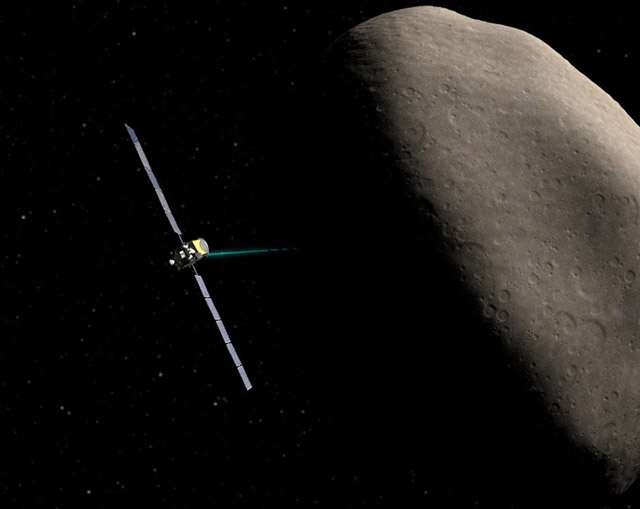
For example, ion propulsion technology flight-tested on the NMP mission Deep Space 1, launched in October 1998, is now flying aboard the Dawn mission. Dawn will be the first probe to orbit an asteroid (Vesta) and then travel to and orbit a dwarf planet (Ceres). The highly efficient ion engine is vital to the success of the 3 billion mile, 8 year journey. The mission could not have been flown using conventional chemical propulsion; launching the enormous amount of fuel required would have broken the project’s budget. “Ion propulsion was the only practical way,â€? says Stevens.

In total, 10 technologies tested by Deep Space 1 have been adopted by more than 20 robotic probes. One, the Small Deep Space Transponder, has become the standard system for Earth communications for all deep-space missions.

And Deep Space 1 is just one of NMP’s missions. About a half-dozen others have flown or will fly, and their advanced technologies are only beginning to be adopted. That’s because it takes years to design probes that use these technologies, but Stevens says experience shows that “if you validate experimental technologies in space, and reduce the risk of using them, missions will pick them up.â€?

Stevens knew many of these technologies when they were just a glimmer in an engineer’s eye. Now they’re “all grown upâ€? and flying around the solar system. It’s enough to make a program manager proud!

The results of all NMP’s technology validations are online and the list is impressive: http://nmp.nasa.gov/TECHNOLOGY/scorecard/scorecard_results.cfm. For kids, the rhyming storybook, “Professor Starr’s Dream Trip: Or, How a Little Technology Goes a Long Way” at spaceplace.nasa.gov/en/kids/nmp/starr gives a scientist’s perspective on the technology that makes possible the Dawn mission.

This article was provided by the Jet Propulsion Laboratory, California Institute of Technology, under a contract with the National Aeronautics and Space Administration.

Dawn and Ceres

Caption:

Dawn will be the first spacecraft to establish orbits around two separate target bodies during its mission—thanks to ion propulsion validated by Deep Space 1.